

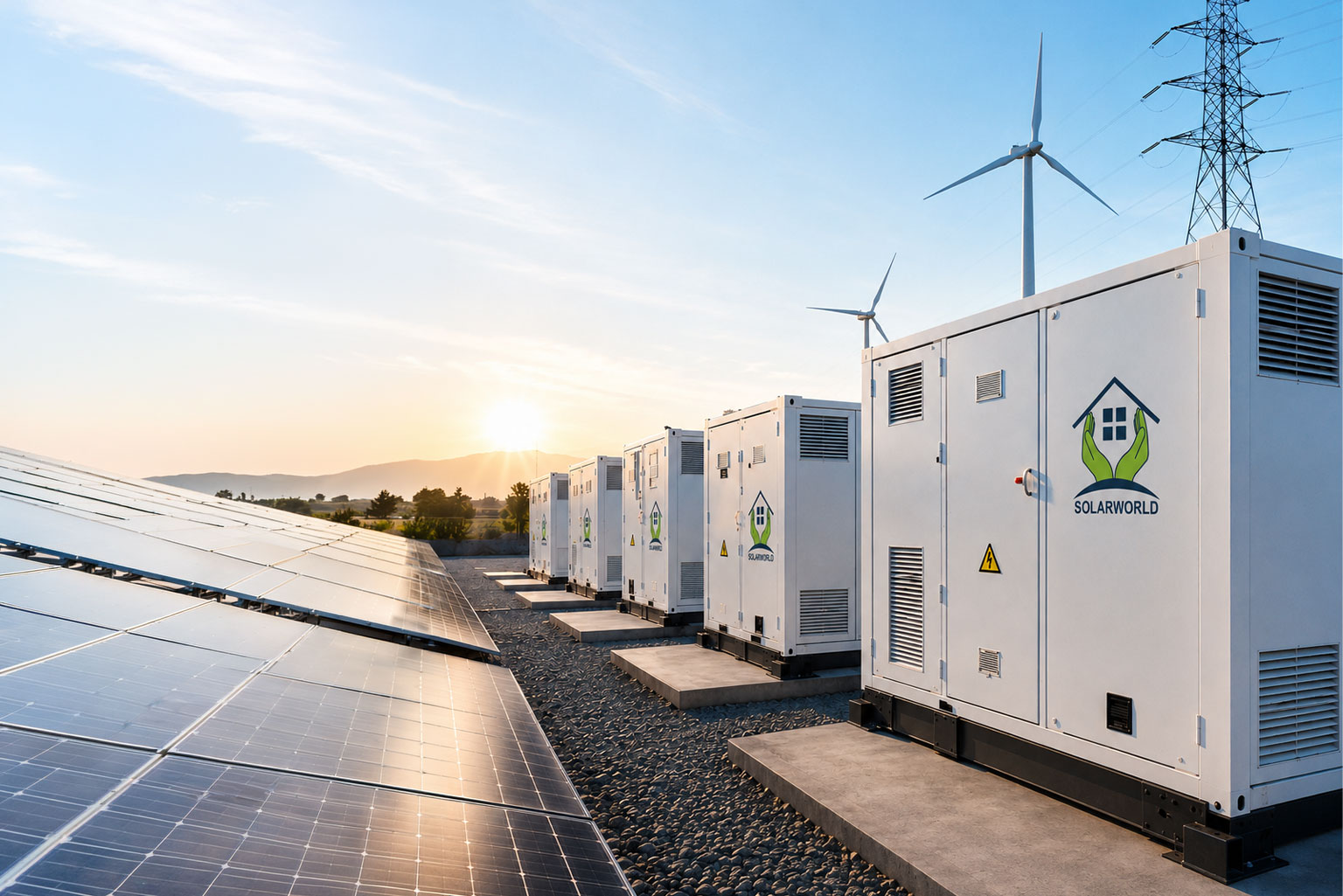
BESS Explained: How Battery Energy Storage Systems Improve Solar Performance
Everything you need to know about Battery Energy Storage Systems — from core technology to real-world benefits for commercial and industrial solar users in India.
What Is a Battery Energy Storage System (BESS)?
A Battery Energy Storage System is an integrated platform of batteries, power conversion equipment, and intelligent software that captures electrical energy and delivers it on demand. In a solar context, the system works alongside your photovoltaic (PV) array: excess daytime generation is stored in the battery bank instead of being fed back to the grid or simply wasted.
Modern BESS solutions are built around lithium-ion chemistry — particularly Lithium Iron Phosphate (LiFePO₄) cells, renowned for thermal stability, deep-cycle durability, and a long operational lifespan. The system's intelligence sits in the Battery Management System (BMS) and Energy Management System (EMS), which continuously monitor cell health, state of charge, temperature, and grid conditions to optimise every charge and discharge cycle.
How Does a BESS Work? — The 4-Stage Cycle
☀️ Solar Generation & Charging
During daylight hours, solar panels produce more electricity than the facility consumes. The surplus flows into the battery bank, where it is stored as chemical energy at an efficiency of up to 95%.
🔋 State-of-Charge Monitoring
The Battery Management System tracks each cell's voltage, temperature, and state of charge in real time, preventing overcharging and deep discharge — the two main causes of battery degradation.
⚡ Intelligent Discharge
When solar output drops — at night, during cloudy weather, or during peak tariff hours — the Energy Management System directs stored power to loads, seamlessly replacing grid power.
🔗 Grid Interaction & Export
Excess stored energy can be exported to the grid under net metering or sold through open-access arrangements, turning your storage asset into a revenue generator.
A solar system without storage is like a bucket with a hole — you capture the rain, but you can't keep it. BESS seals that hole and puts your energy to work around the clock.
— Solarworld TeamKey Benefits of Integrating BESS with Your Solar System
Battery energy storage transforms a standard solar installation into a fully dispatchable power asset. Here are the most impactful advantages for commercial and industrial users:
Lower Energy Bills
Shift stored solar energy to cover peak-tariff hours and significantly cut your monthly electricity spend.
Grid Independence
Reduce reliance on an unreliable grid. BESS provides a seamless backup, keeping operations running during outages.
Maximised Solar ROI
Instead of exporting cheap power and importing expensive power, store and self-consume — improving returns on your solar investment.
Demand Charge Reduction
Flatten power demand spikes that trigger hefty ToD and demand charges from DISCOMs, often the single largest billing component.
Carbon Footprint Reduction
Displace diesel gensets and grid power from coal-heavy sources — a measurable step toward your sustainability and ESG targets.
Power Quality Improvement
BESS acts as a buffer against voltage fluctuations and frequency deviations, protecting sensitive equipment and reducing downtime.
Why BESS Solutions Are Critical for India in 2025
India's energy landscape is at an inflection point. With the government targeting 500 GW of renewable energy by 2030 and electricity demand growing at 6–7% per year, the grid is under increasing strain. State DISCOMs face acute challenges in managing evening demand peaks — precisely when solar generation has ended.
For commercial and industrial consumers, the pain is real: rising Time-of-Day (ToD) tariffs, unpredictable load-shedding, costly demand charges, and diesel backup costs that erode profitability. BESS solutions in India directly address all four pressure points.
Policy support is accelerating adoption. The MNRE's Viability Gap Funding (VGF) scheme for standalone BESS, the Production Linked Incentive (PLI) for Advanced Chemistry Cell batteries, and state-level open access reforms are making commercial battery storage economically viable at scale — faster than ever before.
| Challenge | Without BESS | With BESS |
|---|---|---|
| Evening peak tariff (ToD) | ✗ Pay peak rates from grid | ✓ Discharge stored solar |
| Grid outages / load shedding | ✗ Run diesel generator | ✓ Seamless battery backup |
| Demand charge spikes | ✗ Full billing impact | ✓ Peak shaving reduces charge |
| Excess solar (curtailment) | ✗ Energy wasted or exported cheaply | ✓ Stored and self-consumed |
| ESG / carbon reporting | ✗ Higher grid emission factor | ✓ Near-zero carbon consumption |
Commercial Battery Storage: Ideal Use Cases
BESS technology is versatile and scales from 50 kWh rooftop systems to multi-MWh utility-scale plants. Here are the most common commercial applications SolarWorld deploys:
Manufacturing & Industrial Facilities
Eliminate demand charges, protect sensitive machinery from voltage sags, and remove dependence on costly diesel DG sets during grid failures.
Commercial Buildings & IT Parks
Reduce ToD billing by 35–50%, achieve LEED/IGBC credits with on-site renewable storage, and guarantee power continuity for 24×7 operations.
Real Estate & Mixed-Use Developments
Integrated BESS + solar systems deliver common-area power, EV charging infrastructure, and a compelling green credential for tenants.
Agri-Processing & Cold Chain
Uninterrupted refrigeration and pumping is critical. Battery storage ensures round-the-clock power without grid dependency in rural locations.
Hospitality & Healthcare
Power reliability is non-negotiable. BESS provides seamless UPS-grade backup while simultaneously reducing energy costs and carbon emissions.
EV Charging Hubs
Avoid costly grid upgrades by coupling BESS with solar to manage high-power DC fast-charging loads without demand charge penalties.
What to Look for in a BESS Solution Provider
Choosing the right partner for your energy storage system is as important as the technology itself. Here is what to evaluate:
1. End-to-End System Design Expertise
Your BESS must be sized and configured for your specific load profile, tariff structure, and solar generation curve. Avoid one-size-fits-all packages. Demand detailed energy modelling that demonstrates the projected payback period and savings for your facility.
2. Tier-1 Battery Technology
Insist on LiFePO₄ chemistry from established cell manufacturers. Evaluate cycle life (look for 4,000+ cycles at 80% Depth of Discharge), thermal management systems, and certifications such as UL 9540, IEC 62619, and BIS compliance for the Indian market.
3. Advanced Energy Management System (EMS)
The EMS should offer predictive dispatch using weather and load forecasts, ToD tariff optimisation, remote monitoring, and over-the-air firmware updates. A cloud-connected EMS with a user-friendly dashboard gives you full visibility and control.
4. O&M Support and Performance Guarantees
A reputable provider will back their system with performance guarantees, comprehensive O&M contracts, and a local service team. Ask about response times, spare-parts availability, and contracted energy yield.
5. Financial Structuring & Incentive Knowledge
CAPEX, OPEX/RESCO, and hybrid financing models all have different implications for your balance sheet. A good partner will also help you navigate applicable subsidies, accelerated depreciation benefits, and VGF schemes to optimise your total investment cost.
The SolarWorld Approach to BESS in India
At SolarWorld Energy Solutions Limited, we have deployed integrated solar and battery energy storage systems across manufacturing, commercial, and infrastructure sectors throughout India. Our engineering-first approach means every project begins with a detailed load analysis and financial model — we do not propose a BESS unless the numbers work for you.
We partner with globally certified Tier-1 battery manufacturers and pair their technology with our proprietary EMS platform, giving our clients real-time visibility into generation, storage, consumption, and grid interaction from a single dashboard.
Our BESS installations have consistently delivered electricity cost reductions of 30–45% for commercial clients, with typical payback periods of 4–6 years depending on tariff structure and solar generation profile.
Ready to Unlock the Full Potential of Your Solar System?
Get a free BESS feasibility assessment from SolarWorld's energy engineers.
We'll analyse your load profile and show you exactly what storage can save.
Tagged